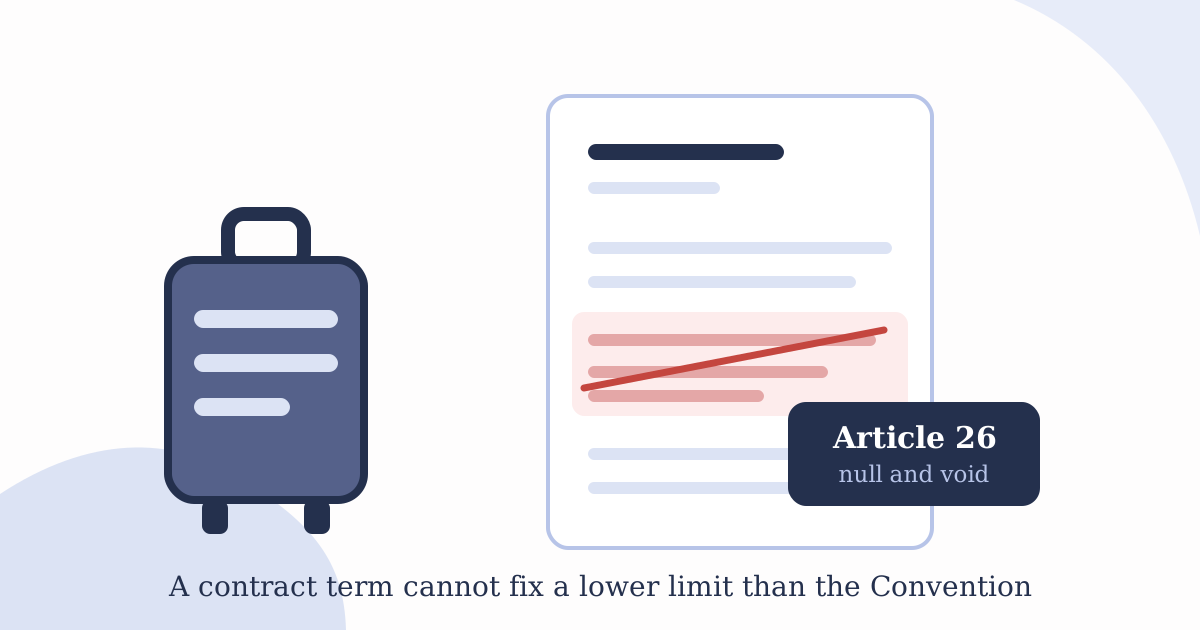
Almost every airline publishes a list of items it says should not be in checked baggage and for which it accepts no liability. That list is a contract term, and Article 26 of the Montreal Convention says any provision tending to relieve the carrier of liability or to fix a lower limit than the Convention lays down is null and void. Liability for checked baggage under Article 17(2) attaches to the bag, not to a schedule of approved contents, and the single exception is damage caused by the inherent defect, quality or vice of the baggage itself. So a refusal that consists only of quoting the excluded-items list is answerable: ask which Convention provision the carrier relies on, restate the loss with evidence, and keep inside the 7 and 21 day complaint windows while you do it.
What the excluded-items clause actually is
Open the conditions of carriage of almost any airline and you will find a clause telling you not to put certain things in checked baggage: laptops and cameras, phones and tablets, jewellery, cash, keys, travel documents, medication, fragile or perishable goods, business papers and samples. The clause usually ends by saying the carrier accepts no liability for those items if they are checked in anyway.
Two different things are packed into that sentence and it is worth pulling them apart. The first is advice, and it is good advice: a suitcase goes through belts, chutes and handlers, and a laptop is safer in the cabin. The second is a limitation of liability, and that is a contract term the airline has written in its own favour. Passengers usually read the whole clause as a rule of law. It is not one.
The distinction matters because when a claim for a broken laptop or a missing camera is refused, the refusal almost always consists of quoting that clause back to you and nothing else. Whether that answer is any good depends on what the Convention says a carrier is allowed to put in its own conditions.
- The list is a term of the contract of carriage, not a provision of the treaty.
- It mixes sensible packing advice with a limitation of liability.
- A refusal that only cites the list has not yet engaged with the Convention.
Article 26: a clause that lowers the limit is null and void
The Montreal Convention anticipates exactly this. Article 26 reads: “Any provision tending to relieve the carrier of liability or to fix a lower limit than that which is laid down in this Convention shall be null and void, but the nullity of any such provision does not involve the nullity of the whole contract, which shall remain subject to the provisions of this Convention.”
Read that against the excluded-items clause. A term saying the carrier accepts no liability for a category of checked property is, on its face, a provision tending to relieve the carrier of liability. Article 26 does not ask the passenger to negotiate it away or to have read it before flying. It says the term is void, and that the rest of the contract carries on governed by the Convention.
Article 27 is the other half of the picture and explains why the clause exists at all. Carriers are free to lay down conditions, but only conditions “which do not conflict with the provisions of this Convention”. So an airline may tell you what to pack and where. What it may not do is contract out of the liability the treaty imposes on it.
- Article 26 voids provisions that relieve the carrier or lower the limit.
- The rest of the contract survives and is read subject to the Convention.
- Article 27 lets carriers set conditions, but not ones that conflict with the treaty.
Liability attaches to the bag, not to a list of contents
Article 17(2) sets out when the carrier is liable for checked baggage: “The carrier is liable for damage sustained in case of destruction or loss of, or of damage to, checked baggage upon condition only that the event which caused the destruction, loss or damage took place on board the aircraft or during any period within which the checked baggage was in the charge of the carrier. However, the carrier is not liable if and to the extent that the damage resulted from the inherent defect, quality or vice of the baggage.”
The words “upon condition only” are doing real work. The test is where the bag was when the damaging event happened, and that is the whole test. There is no second condition about what was inside, no schedule of approved contents, and no requirement that the passenger followed the airline's packing guidance. The one carve-out concerns the inherent defect, quality or vice of the baggage itself, and it is drafted as an exception the carrier has to establish.
Unchecked baggage is treated differently in the same article: for cabin bags and personal items the carrier is liable only if the damage resulted from its fault. That asymmetry is deliberate, and it is another reason the excluded-items clause is worth reading carefully. Once a bag is checked, the strict standard applies to it.
- The Article 17(2) test is where the bag was, not what was in it.
- The only baggage-specific exception is inherent defect, and the carrier must prove it.
- Checked baggage carries strict liability; cabin items require fault.
Where the real limits are
None of this makes the airline liable without limit, and it is worth being precise about the ceiling rather than overstating the claim. Article 22(2) caps liability for destruction, loss, damage or delay of baggage at a fixed number of Special Drawing Rights per passenger. The figure in the treaty text is 1,000 SDR, and the Article 24 review mechanism has revised it upward over time: the ICAO revision effective from December 2024 sets the current limit at 1,519 SDR, roughly 1,800 euros depending on the exchange rate on the day.
That is a ceiling, not an entitlement, and inside it you are paid what you can prove. A single high-value item can exhaust it on its own, which is the practical reason airlines would rather you did not check a camera body worth more than the cap.
Article 22(2) also contains the mechanism that changes the ceiling. A passenger who makes a special declaration of interest in delivery at destination when handing the bag over, and pays a supplementary sum if required, moves the limit to the declared amount. The carrier can still argue the declared sum exceeds the passenger's actual interest, but the declaration is the route the treaty itself provides for genuinely valuable checked property. It has to be made at check-in, which is precisely when nobody thinks of it.
Article 20 is the other genuine limit. If the carrier proves the damage was caused or contributed to by the claimant's own negligence, its liability is reduced or removed to that extent. This is where an airline can make a real argument about a fragile item packed loose among hard objects, and it is a much stronger argument than pointing at the excluded-items list. But it is a case the carrier has to actually make on the facts.
- Article 22(2) caps baggage liability at 1,519 SDR per passenger under the 2024 revision.
- A special declaration of interest at check-in can raise the applicable ceiling.
- Article 20 reduces liability where the passenger's own negligence contributed.
- Both are limits on the amount, not permission to exclude a category of contents.
How to answer the refusal
Keep the reply short, factual and in writing, in the channel that produced the refusal, quoting the report reference. Say that you have read the excluded-items clause, that Article 26 makes a provision relieving the carrier of liability null and void, and ask which provision of the Convention the carrier relies on to decline. That one question moves the exchange from a policy document to the treaty, which is the ground the claim stands on.
Then restate the loss the way you would in any claim: what the item was, what it was worth, and what evidence supports the figure. Purchase receipts, a serial number, photographs of the bag and its contents before the flight, and a repair quote or an irreparability statement where the item was damaged rather than lost. If the airline argues negligent packing, describe how the item was packed. A written answer to a specific allegation is far more useful than a general complaint.
Two things to avoid. Do not claim the cap as though it were the amount owed: the 1,519 SDR figure is the ceiling on liability, and treating it as an entitlement weakens an otherwise sound claim. And do not let the negotiation eat the deadlines, which is the most common way a good claim dies.
- Ask which Convention provision supports the refusal, in writing.
- Restate the item, the value and the evidence behind it.
- Answer a negligent-packing argument with how the item was actually packed.
- Claim the documented loss, not the cap.
The deadlines do not pause while you argue
Article 31 sets the complaint windows and they run from receipt of the bag, not from the date the airline refuses. For damage, the written complaint is due within 7 days of receiving the checked baggage. For delay, it is 21 days from the date the bag was placed at your disposal. Article 31(4) is blunt about what happens otherwise: if no complaint is made within those times, no action shall lie against the carrier, save in the case of fraud on its part.
So if a claim is refused on excluded-items grounds and you are still inside the window, the priority is to get the written complaint in rather than to win the argument first. A short letter that identifies the flight, the bag, the damage and the loss protects the position while the discussion continues.
Article 35 sets the outer boundary: the right to damages is extinguished if an action is not brought within two years from the date of arrival, the date the aircraft ought to have arrived, or the date carriage stopped. A dispute that drifts amiably for eighteen months has quietly spent most of the available time.
- Damage: written complaint within 7 days of receiving the bag.
- Delay: written complaint within 21 days of the bag being returned.
- Missing the window bars the action entirely, absent fraud.
- Two years from arrival to bring a legal action under Article 35.
What to keep on file
A claim of this kind turns on evidence about a specific item rather than on the general strength of the argument, so the file should make the item concrete.
- the PIR or file reference and the date it was created
- the refusal itself, in full, including the clause it quotes
- purchase receipt, serial number or other proof of value and ownership
- photographs of the item and of the bag, before and after where possible
- a repair quote or written statement that repair is not possible
- the arrival date, so both the complaint window and the two-year deadline stay visible
Sources primaires
Nous nous appuyons sur des sources primaires et officielles pour les délais et le cadre de responsabilité présentés dans ce guide. Les conditions de la compagnie et les faits propres à chaque voyage doivent encore être vérifiés.
Transformez la liste de contrôle en une réclamation prête à relire.
Vérifiez la chronologie, classez les reçus et rédigez la lettre avant d'ouvrir la voie de dépôt officielle de la compagnie.
Vérifier ma réclamation