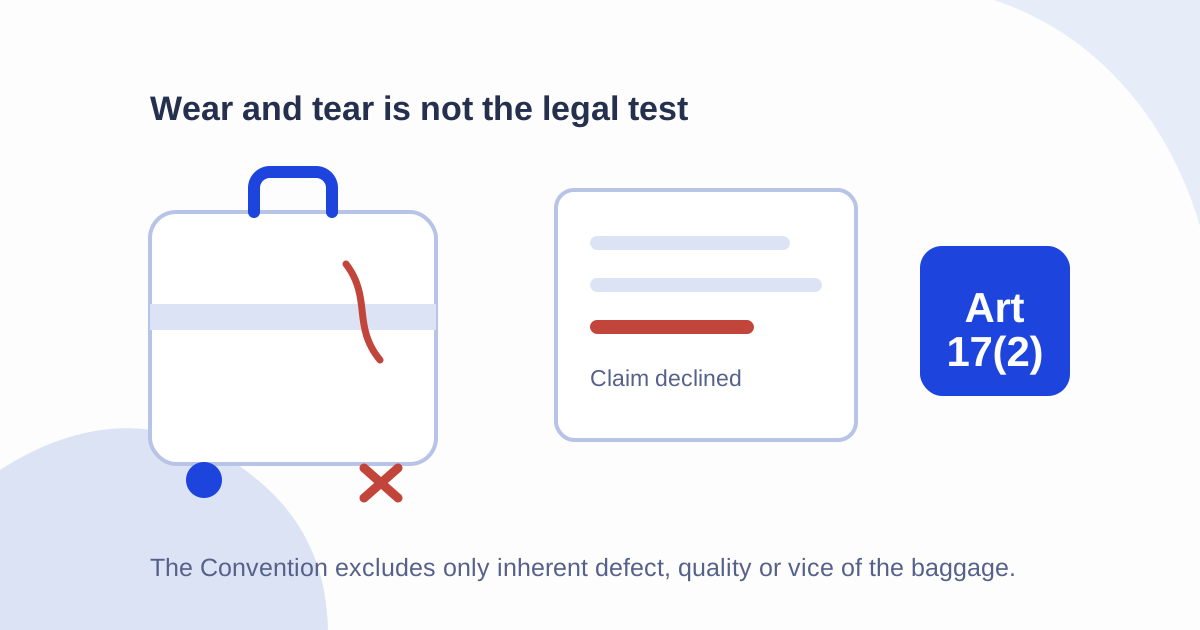
“Normal wear and tear” is a phrase from the airline's own baggage policy, not a rule of the Montreal Convention. Article 17(2) makes the carrier liable for damage to checked baggage whenever the event that caused it happened while the bag was in the carrier's charge, and gives the carrier one escape: damage that resulted from the inherent defect, quality or vice of the baggage. That is an exception the airline must establish, not a label it can apply. So the reply is to show the bag was serviceable on departure, that the damage is structural rather than cosmetic ageing, and that your written complaint went in within seven days of receiving the bag under Article 31(2).
The words the Convention uses, and the ones it does not
Article 17(2) is short enough to quote in full in a complaint: “The carrier is liable for damage sustained in case of destruction or loss of, or of damage to, checked baggage upon condition only that the event which caused the destruction, loss or damage took place on board the aircraft or during any period within which the checked baggage was in the charge of the carrier. However, the carrier is not liable if and to the extent that the damage resulted from the inherent defect, quality or vice of the baggage.”
Two things follow. First, liability is strict for checked bags: you do not have to prove the handler was careless, only that the damaging event happened while the airline held the bag. Second, the only baggage-specific way out is the inherent defect clause, and it is drafted as an exception, which is why the words “if and to the extent that” appear. An exception has to be made out by the party relying on it.
The phrase “wear and tear” appears nowhere in the treaty. It appears in conditions of carriage and in the exclusion lists published on airline baggage pages, alongside scratches, scuffs, dents, cuts to the outer fabric, and loss of protruding parts such as wheels, feet, handles, straps and locks. Those lists are commercial policy. Article 26 of the Convention says any provision tending to relieve the carrier of liability or to fix a lower limit than the Convention lays down is null and void, so an exclusion list cannot do work that Article 17(2) does not permit.
What inherent defect actually means
Inherent defect, quality or vice describes something in the nature of the object that caused its own damage: a case whose frame was already cracked when you handed it over, a seam that had begun to part, a shell that had gone brittle with age, a lock that was broken before the flight. The idea is that the airline should not pay for a bag that failed because it was already failing.
It is not a synonym for “old” or for “this kind of mark is common”. A five-year-old suitcase that arrives with a wheel housing torn out of the shell did not tear its own housing out. A handle that snaps under a drop was not defective merely because handles are the part that snaps. If the carrier wants the exception, the sensible question to put back is which specific quality of the bag it says produced this specific damage.
Notice also the words “to the extent that”. The exception is partial by design. Even if some ageing contributed, that does not defeat the whole claim, it reduces it. A refusal that treats a scuffed corner as a reason to decline a broken frame is applying the clause more widely than it reads.
- Inherent defect: the bag failed because of a pre-existing condition of the bag itself.
- Not inherent defect: impact, crushing, tearing or shearing caused by handling.
- The carrier relies on the exception, so the carrier has to make it out.
- The clause reduces liability to the extent it applies, it does not switch it off.
Sort the damage into cosmetic and structural before you write
Refusals are easiest to answer when the claim is precise, and precision here means separating marks from failures. A scuff on the shell and a sheared wheel mount are different claims with different strength, and bundling them invites one dismissive reply covering both.
Structural damage is anything that stops the bag doing its job: a wheel or its housing, a telescopic handle that no longer locks, a zip line torn from the fabric, a cracked or punctured shell, a hinge or latch that will not close, a frame bent so the case no longer sits square. Cosmetic damage is surface marking on a case that still functions. If your claim is structural, say so in the first sentence and let the photographs prove it, rather than opening with a list of scratches.
Then price it honestly. Ask a repairer for a written quote first, because on a mid-range case a wheel or handle replacement is often cheaper than a new bag, and a quote is far harder to argue with than an estimate. Where the case is genuinely beyond repair, a replacement price for an equivalent bag, not an upgrade, is the number to put forward.
- Photograph the closed bag with the airline tag still attached, then each failure point.
- Describe the mechanism: torn out, sheared, cracked, crushed, rather than “damaged”.
- Get a written repair quote before asking for a replacement price.
- Keep the bag unrepaired until the claim is decided, since carriers may inspect.
Evidence that the bag was serviceable when you handed it over
Because the exception is about the condition of the bag before the flight, the most useful evidence you can add is anything showing it was intact at check-in. Very few people photograph a suitcase on the way out, so look for the record you already have rather than the one you wish you had.
Holiday and airport photographs often show the case in the background. So does a phone photo of a packed bag at home, a purchase receipt or order confirmation establishing the model and its age, and the absence of any note on the check-in record. If you travelled on the outbound leg with the same case and it arrived fine, say that: the same bag survived one flight and failed on the other, which is difficult to attribute to the bag.
Article 20 is worth knowing about here too, because it is the other route to a reduction. It lets the carrier be wholly or partly exonerated to the extent that the damage was caused or contributed to by the claimant's own negligence. That is the clause behind refusals aimed at overpacking or at fragile items packed in checked baggage. Like the inherent defect exception, it is something the carrier must prove, and it is proportionate rather than absolute.
None of this survives the seven-day deadline
The substantive argument only matters if the claim is alive. Article 31(2) requires a complaint to the carrier forthwith after the damage is discovered and at the latest within seven days from the date of receipt of the checked bag. Article 31(3) requires it in writing and dispatched inside that period, and Article 31(4) says that if no complaint is made within the time aforesaid, no action shall lie against the carrier, save in the case of fraud on its part.
The European Union states the same in plain language. The information notice annexed to Regulation (EC) No 889/2002 tells passengers that in the case of damage to checked baggage the passenger must write and complain within seven days, and within 21 days for delay, in both cases from the date the baggage was placed at the passenger's disposal.
So the order of operations is: write first, argue second. A short written complaint on day two that names the flight, the file reference and the damage preserves everything, and the repair quote, the photographs and the answer to the wear and tear line can all follow. Waiting until the evidence pack is perfect is how good claims are lost on a technicality.
- Damage: written complaint within 7 days of receiving the bag.
- Delay: 21 days from the date the bag was placed at your disposal.
- Any court action: 2 years from arrival, under Article 35.
How to answer the refusal itself
Keep the reply to one page and make it answerable. Open with the flight, the date and the baggage file reference, then confirm the date you received the bag and the date your written complaint was sent, so the seven-day point is closed before anything else is discussed.
Next, address the phrase directly. State that the decision relies on a wear and tear exclusion, that the applicable test in Article 17(2) is inherent defect, quality or vice of the baggage, and ask the airline to identify which quality of the bag it says caused this damage. Describe the failure mechanically, attach the photographs with the tag visible and the repair quote, and add whatever shows the case was serviceable on departure.
Finally, keep the amount modest and evidenced. The Montreal Convention baggage limit is 1,519 Special Drawing Rights per passenger from 28 December 2024, and it is a ceiling on proven loss rather than a sum anyone is entitled to. A repair quote of a couple of hundred euros, fully documented, is a much stronger position than a replacement claim for the newest model, and it makes the request easy for a reviewer to approve.
- Flight, date and baggage file reference at the top.
- Dates of receipt and of the written complaint, showing the 7 days were met.
- The Article 17(2) test quoted, and the question of which defect is alleged.
- Photographs with the tag attached, plus a written repair or replacement quote.
- A request for a written decision on the evidence supplied.
Sources primaires
Nous nous appuyons sur des sources primaires et officielles pour les délais et le cadre de responsabilité présentés dans ce guide. Les conditions de la compagnie et les faits propres à chaque voyage doivent encore être vérifiés.
Transformez la liste de contrôle en une réclamation prête à relire.
Vérifiez la chronologie, classez les reçus et rédigez la lettre avant d'ouvrir la voie de dépôt officielle de la compagnie.
Vérifier ma réclamation