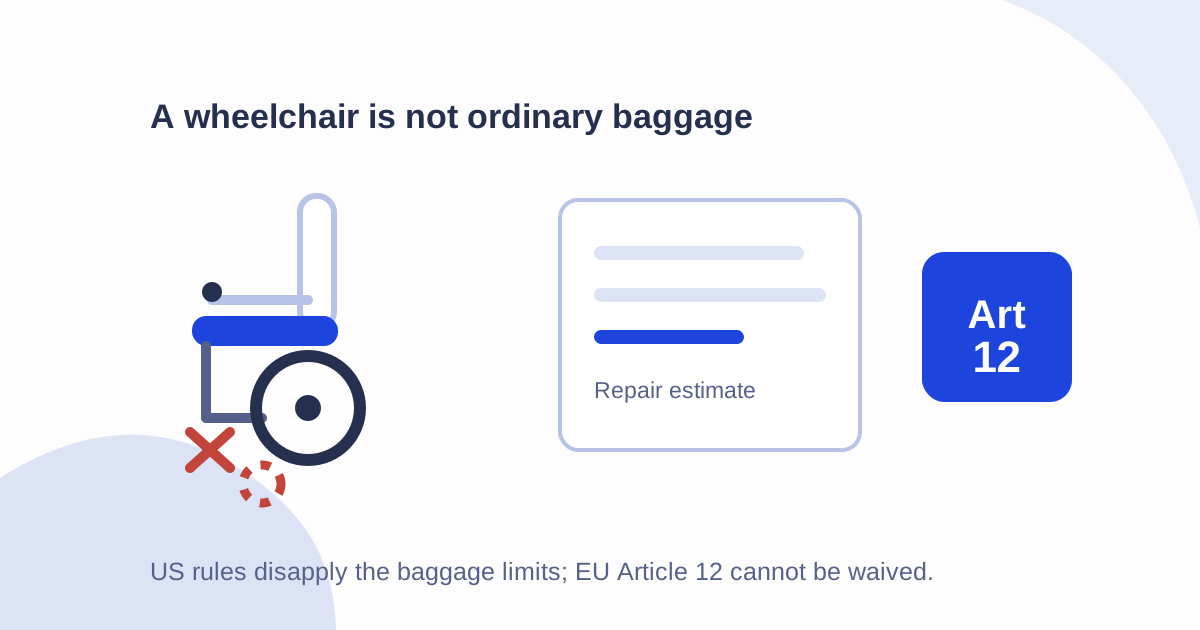
Do not let a wheelchair claim be processed as ordinary baggage. For flights covered by 14 CFR part 254, US rule 14 CFR 382.131 states that the part 254 liability limits do not apply to wheelchairs and assistive devices, and that compensation is calculated on the original purchase price of the device. In the EU, Article 12 of Regulation 1107/2006 requires that a passenger whose mobility equipment is lost or damaged during airport handling or on board is compensated, and Article 13 forbids limiting or waiving that obligation. On a purely international route with no such rule, the Montreal Convention cap applies unless you made a special declaration of interest at check-in under Article 22(2). Report before leaving the airport, keep the equipment, get a repair or replacement quote from the manufacturer or a specialist dealer, and claim interim equipment as a separate head of loss.
Why the usual baggage answer is the wrong one
Almost every baggage claim starts from the same figure: liability is capped at 1,519 SDR per passenger, roughly 1,800 euros. For a suitcase that ceiling is generous. For a powered wheelchair it can be a fraction of the loss, because a custom powered chair frequently costs several times that amount and is not a consumer good the passenger can simply replace from stock.
This is exactly why separate rules exist, and why the first move in a mobility-equipment claim is to establish which regime governs the flight before discussing amounts. Airline front-line staff and claim forms are built around ordinary baggage, so the cap tends to be quoted automatically. It is frequently not the applicable limit, and accepting it early is the most common way these claims are underpaid.
A second difference matters just as much. A damaged suitcase is an inconvenience; damaged mobility equipment removes the passenger's independence from the moment the aircraft doors open. That consequential element, the cost of hire equipment and the practical loss while a chair is repaired, is part of the claim and is regularly left out of a first offer.
- Establish which regime applies before you discuss any figure.
- The 1,519 SDR baggage cap is often not the operative limit for mobility equipment.
- Loss of use, including hire equipment, is a distinct head of loss.
Flights under US rules: the baggage limits are disapplied
The clearest rule anywhere is the US one, and it is short enough to quote in full. 14 CFR 382.131 asks whether baggage liability limits apply to mobility aids and other assistive devices, and answers: "With respect to transportation to which 14 CFR part 254 applies, the limits to liability for loss, damage, or delay concerning wheelchairs or other assistive devices provided in part 254 do not apply. The basis for calculating the compensation for a lost, damaged, or destroyed wheelchair or other assistive device shall be the original purchase price of the device."
Two things follow. The domestic baggage liability ceiling is removed for this category rather than raised, and the measure of compensation is fixed as the original purchase price of the device, not its depreciated second-hand value. That is a materially different basis from an ordinary baggage claim, where age and use reduce what you recover. If a carrier offers a depreciated figure on a route where this rule applies, the regulation itself is the answer.
Quote the provision by number in writing. The point of doing so is not legal theatre: the claim is often handled by a general baggage team that applies its standard depreciation matrix, and citing the section is what moves the file to someone who knows the category is different.
- 14 CFR 382.131 disapplies the part 254 limits for wheelchairs and assistive devices.
- Compensation is calculated on the original purchase price of the device.
- Depreciation is not the basis where this rule governs the flight.
EU flights: Article 12, and an obligation that cannot be waived
In the EU the relevant instrument is Regulation (EC) No 1107/2006 on the rights of disabled persons and persons with reduced mobility when travelling by air. Article 12 is headed "Compensation for lost or damaged wheelchairs, other mobility equipment and assistive devices" and provides that where such equipment is lost or damaged whilst being handled at the airport or transported on board aircraft, the passenger to whom the equipment belongs shall be compensated, in accordance with rules of international, Community and national law.
Read carefully, Article 12 does not itself set a figure; it directs you to the applicable rules of international, EU and national law for the amount. What it does do is establish the entitlement and, importantly, extend it to handling at the airport, which covers the ground-handling operation where most of this damage actually happens rather than only carriage on board.
Article 13 is the provision that gives it teeth. It states that obligations towards disabled persons and persons with reduced mobility under the Regulation shall not be limited or waived. So a term in the carrier's conditions purporting to exclude or cap liability for mobility equipment is running against Article 13, and that is worth saying plainly in correspondence when a refusal is based on the airline's own conditions of carriage.
- Article 12 covers loss or damage during airport handling as well as on board.
- Article 12 establishes the entitlement and refers the amount to international, EU and national law.
- Article 13 prevents the obligation being limited or waived by the carrier's own terms.
- The national enforcement body designated under the Regulation is the escalation route.
The special declaration, and why it is worth the trouble
Where no disapplying rule governs the route, the Montreal Convention limit is the default. Article 22(2) caps liability for destruction, loss, damage or delay of checked baggage per passenger, "unless the passenger has made, at the time when the checked baggage was handed over to the carrier, a special declaration of interest in delivery at destination and has paid a supplementary sum if the case so requires. In that case the carrier will be liable to pay a sum not exceeding the declared sum."
For a chair worth several times the cap, that declaration is the only mechanism in the treaty for lifting the ceiling to something near the real value. The timing requirement is strict and unforgiving: it must be made when the equipment is handed over, which means at check-in or at the gate when the chair is taken, not afterwards and not once damage is discovered.
Practically, ask the carrier before travelling how it takes a declaration for mobility equipment and what supplementary sum, if any, it charges. Some carriers publish a specific form for this. Do it in advance, because the desk on the day is the worst moment to be discovering an airline's internal process.
- The declaration must be made when the equipment is handed over, not later.
- It raises the ceiling to the declared sum, subject to any supplementary charge.
- Ask the carrier in advance which form or process it uses.
What to do in the first hour
The evidence in a mobility-equipment claim is the equipment itself, so the priority is to have the damage recorded while the chair is still in the airline's presence and before anyone takes it away for repair. Damage is often visible as soon as the chair comes up the jet bridge, which is the right moment to raise it.
Have the report created there, in the terms you will use later: which component failed, whether it is the frame, a wheel, a joystick, a footplate, a battery mount or the seating system. Photograph the damage from several angles with the baggage or gate tag in shot. If the chair is unusable, say so in the report and record what interim equipment you were given, or that you were given none.
Do not accept an on-the-spot repair by the airline's contractor without recording the pre-repair condition first. A repair carried out immediately can be entirely reasonable, but once the chair has been worked on the evidence of the original damage is gone, and with it the ability to argue about whether the repair was adequate.
- Raise the damage at the aircraft or in the arrivals hall, not after leaving.
- Name the failed component precisely in the report.
- Photograph the damage with the tag visible, before any repair.
- Record what interim equipment was offered, and whether it met your needs.
Building the figure
Mobility equipment is not valued the way a suitcase is, because it is usually prescribed, configured or built for one person. A quote from the manufacturer or an authorised specialist dealer is the document that carries weight, and it should state whether the chair can be repaired to its previous condition or whether the damage is beyond economic repair.
Where the equipment was individually fitted, say so explicitly and evidence it. A seating system set up for one person's posture is not restored by supplying a similar model from stock, and the assessment or fitting cost is part of putting you back in the position you were in. Include the original purchase invoice where you still have it, which on US-governed routes is the direct basis for the figure under 382.131.
Interim costs belong in the claim as a separate line: hire of a replacement chair, the additional transport you needed because your own equipment was unavailable, and any care costs that arose directly from that. Keep them itemised and receipted, and keep them apart from the repair or replacement figure so the airline cannot settle one and treat the other as included.
- Get a written quote from the manufacturer or an authorised dealer.
- State plainly whether the damage is repairable or beyond economic repair.
- Evidence any individual fitting or configuration and its cost.
- List hire and interim transport costs as separate, receipted lines.
Deadlines still apply
None of the above removes the ordinary complaint deadlines, and the special rules do not create a longer window. Where the Montreal Convention governs the carriage, Article 31(2) requires the written complaint within 7 days of receipt for damage to checked baggage, and Article 31(4) provides that if no complaint is made within those times, no action shall lie against the carrier, save in the case of fraud on its part.
So the sequence is: get the written complaint in inside the short window, and argue about the correct measure of compensation afterwards. A claim that is right on the law and late on the deadline is still lost. If a repair quote will take longer than a week to obtain, file the complaint first stating that the valuation follows.
Article 35 sets the long stop at two years from the date of arrival, the date the aircraft ought to have arrived, or the date on which the carriage stopped. Correspondence does not extend it, and mobility-equipment claims tend to run long because they involve specialist assessments, so keep that date in view from the start.
- File the written complaint within the short window, valuation can follow.
- Missing the complaint period bars the action, absent fraud.
- Two years from arrival to bring a legal action under Article 35.
If the airline applies the baggage cap anyway
The most common refusal is not a refusal at all: it is an offer calculated as though the chair were a suitcase, with the baggage ceiling quoted and depreciation applied. Answer it in writing and on the specific point. Identify the route and the regime, cite the provision, and ask the carrier to state which rule it says governs the flight and on what basis it has applied the baggage limit.
That question is deliberately narrow, because it forces the file off the standard baggage track. On a route where 382.131 applies, the carrier has to explain how the part 254 limits survive a rule that says they do not apply. In the EU, a refusal resting on the airline's own conditions has to be reconciled with Article 13 of Regulation 1107/2006.
If the answer is unsatisfactory or does not come, the enforcement route is the national body designated under the Regulation for EU departures, and the relevant transport regulator for US-governed carriage. Send the complete file: the airport report, the photographs, the specialist quote, the original invoice and the correspondence showing what you asked and what the carrier answered.
- Ask the carrier, in writing, which regime it says governs the flight.
- Require it to justify applying the baggage limit against the specific provision.
- Escalate to the designated national enforcement body with the full file.
Źródła pierwotne
W niniejszym przewodniku wykorzystujemy podstawowe i oficjalne materiały na potrzeby terminów i ram odpowiedzialności. Należy sprawdzić warunki linii lotniczych i fakty dotyczące indywidualnej podróży.
Przekształcić listę kontrolną w roszczenie zwrotne.
Sprawdzić linię czasową, zorganizować paragony i zbudować list przed otwarciem oficjalnej trasy zgłoszenia linii lotniczej.
Sprawdź moją reklamację