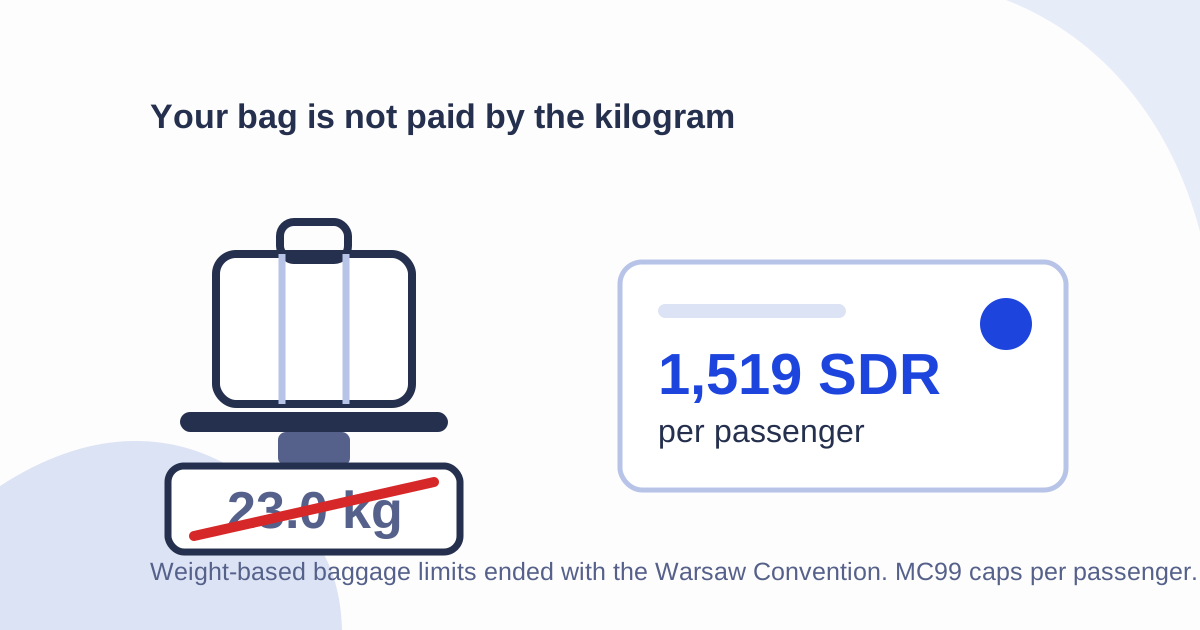
Weight-based baggage compensation comes from Article 22(2) of the 1929 Warsaw Convention, which limited the carrier to 250 francs per kilogramme, later expressed as 17 SDR per kilogramme. The Montreal Convention 1999 replaced that rule for the carriage it governs. Its Article 22(2) limits liability for destruction, loss, damage or delay of baggage to a fixed sum for each passenger, currently 1,519 SDR since 28 December 2024, with no reference to weight at all. Weight survives in Article 22(3), which is about cargo, not passenger baggage. If a carrier offers you kilos multiplied by a rate on a Montreal Convention route, ask in writing which treaty and which article it is applying, and put your proven loss against the per-passenger limit instead.
The offer that gives itself away
The letter arrives with arithmetic in it. Your bag weighed 23 kilograms, the rate is a fixed sum per kilogram, and the product is the settlement. It reads like a calculation from a rulebook, which is exactly why passengers accept it: it looks less like a lowball offer than like the output of a formula nobody can argue with.
There is something to argue with, and it is not the size of the number. It is the instrument. A settlement worked out by weight is being calculated under the 1929 Warsaw Convention, and on most international journeys flown today that is not the treaty in force. On a Montreal Convention route the weight of the bag is not an input to the limit at all.
This matters more than the difference between two figures, because the two rules do different things. The weight rule sets a ceiling that shrinks with a light bag, however valuable its contents. The Montreal rule sets one ceiling per passenger and then asks what you actually lost. A carefully packed 12-kilogram bag holding a laptop and a suit is worth the same under the weight formula as 12 kilograms of paperbacks.
- Kilograms multiplied by a rate is a Warsaw Convention calculation.
- The number is not the problem; the instrument being applied is.
- Weight tracks the bag, not what was inside it.
Where the per-kilo rule actually comes from
Article 22(2)(a) of the Warsaw Convention 1929 provided that in the carriage of registered baggage and of cargo, the liability of the carrier is limited to a sum of 250 francs per kilogramme, unless the passenger or consignor made a special declaration of interest in delivery at destination at the time the package was handed over and paid a supplementary sum if required.
Those francs were gold francs, and the Montreal Protocols converted the amount into the IMF's unit of account, making 250 francs the equivalent of 17 SDR per kilogramme. That figure is the origin of the rate you will see quoted in a weight-based offer, sometimes converted into euros or dollars and rounded.
Article 22(2)(b) of the same treaty then explained how the weight was to be counted where only part of the baggage was affected, taking the total weight of the package or packages concerned. So the whole architecture of the old rule is built around the scale at check-in. That was a deliberate choice in 1929, when air carriage of goods and of passengers' baggage were treated as versions of the same thing.
- Warsaw Article 22(2)(a): 250 francs per kilogramme for registered baggage.
- The Montreal Protocols expressed the same amount as 17 SDR per kilogramme.
- Warsaw Article 22(2)(b) governs how the weight is counted for part of a consignment.
What Article 22(2) of the Montreal Convention says instead
The Montreal Convention 1999 rewrote this provision, and the change is visible on the face of the text. Article 22(2) provides that in the carriage of baggage, the liability of the carrier in the case of destruction, loss, damage or delay is limited to a fixed sum in Special Drawing Rights for each passenger, unless the passenger has made a special declaration of interest in delivery at destination at the time the checked baggage was handed over and paid a supplementary sum if the case so requires.
The words to notice are "for each passenger". There is no multiplier, no rate and no reference to the weight of anything. The figure opened at 1,000 SDR in 1999, was revised to 1,131 SDR from 30 December 2009, to 1,288 SDR from 28 December 2019, and to 1,519 SDR from 28 December 2024 under the review mechanism in Article 24.
Weight has not disappeared from the Convention, which is part of why the confusion survives. Article 22(3) limits liability in the carriage of cargo to a sum per kilogram, currently 26 SDR, and Article 22(4) explains how to count the weight of part of a consignment. Those provisions are about cargo. Applying them to a passenger's suitcase is applying the cargo rule to baggage, and the Convention separates the two into different paragraphs precisely because they are not the same.
- MC99 Article 22(2) fixes the baggage limit for each passenger, not per kilogram.
- The current figure is 1,519 SDR, in force since 28 December 2024.
- The per-kilogram limit in Article 22(3) applies to cargo, not to checked baggage.
A ceiling, not a payout table
Replacing the weight formula does not mean the per-passenger figure is what you receive. The Court of Justice of the European Union addressed this directly in Case C-86/19, holding that the sum in Article 22(2) is a maximum amount of compensation which the passenger does not enjoy automatically and at a fixed rate, and that the amount payable is to be determined within that limit in the light of the circumstances of the case.
The Court also recorded why the treaty is worded as it is. The travaux préparatoires show the drafters intended maximum amounts rather than fixed sums awarded automatically, and although an expression such as "cannot exceed" would have said so more precisely, the drafters used "is limited" because that phrase was already established in the case law on the Warsaw Convention.
The practical consequence is that both extremes are wrong. An airline that pays kilos times a rate is using a superseded instrument; a passenger who demands 1,519 SDR because the bag is gone is claiming a ceiling as an entitlement. What sits between them is proven loss, which is why the evidence of what was in the bag decides the amount.
- Case C-86/19: the Article 22(2) sum is a maximum, not an automatic fixed award.
- The amount is determined within the limit on the circumstances of the case.
- Proven loss, not the ceiling and not the weight, is the measure.
When a weight-based limit can still be the right answer
The Warsaw Convention has not been abolished. It continues to govern carriage between states where the Montreal Convention is not in force between them, and there are still journeys in that position. On such a route, a limit calculated per kilogram may genuinely be the applicable rule rather than a mistake.
This is why the question to put to the carrier is not "why is the offer so low" but "which treaty governs this carriage". That is a factual question with one answer, it turns on the places of departure and destination on your ticket, and it either supports the calculation or removes it.
For flights within the EU, and for EU carriers wherever they fly, the position is settled by EU law rather than left to argument. Regulation 889/2002 amended Regulation 2027/97 so that Community air carriers apply the Montreal Convention liability provisions to the carriage of passengers and their baggage. A weight-based settlement offered by an EU carrier is therefore hard to reconcile with the rules that carrier is bound by.
- Warsaw still governs some routes where MC99 is not in force between both states.
- Ask which treaty applies before arguing about the amount.
- EU carriers apply the MC99 limits under Regulation 889/2002.
How to answer a per-kilogram offer
Keep the reply short and make it about the instrument. State the route, ask the carrier to confirm which convention it says applies to the carriage, and ask it to identify the article under which the compensation has been calculated by weight. Do not open with a counter-figure, because a counter-figure invites a negotiation about the number and quietly accepts the method.
Then put your loss in the letter as a schedule, item by item, with what each thing was, what it cost and what evidence you have. That schedule is what the Montreal Convention asks about, and it is what the CJEU said the national court works from. It also makes the difference between the two methods visible in a single page: the weight calculation on one side, the documented value of what was in the bag on the other.
If the carrier maintains the weight formula on a Montreal route, that answer is worth having in writing before you escalate. Send the national enforcement body, or the court, the correspondence in which the airline states its position, because a settlement calculated under a treaty that does not govern the carriage is a clean point that does not depend on anyone's view of what a suitcase was worth.
- Ask which convention and which article, before discussing amounts.
- Attach an itemised schedule of loss with supporting evidence.
- Get the carrier's position in writing before escalating.
- Watch the complaint deadlines: 7 days for damage, 21 days for delay.
The deadlines do not move because the method is wrong
None of this buys extra time. Article 31(2) of the Montreal Convention requires the written complaint within 7 days of receipt for damage to checked baggage and, where baggage is delayed, within 21 days from the date it was placed at the passenger's disposal. Article 31(4) provides that if no complaint is made within those times, no action lies against the carrier, save in the case of fraud on its part.
So the order of operations matters. File the complaint inside the short window and argue about the correct measure afterwards. An argument that is right about the treaty and late under Article 31 is still an argument you lose.
Article 35 sets the outer limit at two years, reckoned from the date of arrival at the destination, the date on which the aircraft ought to have arrived, or the date on which the carriage stopped. A long exchange of letters about whether the offer should have been calculated by weight consumes that period without extending it.
- 7 days for damage, 21 days for delayed baggage, under Article 31(2).
- Miss the complaint period and the action is barred, absent fraud.
- Two years from arrival under Article 35, and correspondence does not extend it.
Źródła pierwotne
W niniejszym przewodniku wykorzystujemy podstawowe i oficjalne materiały na potrzeby terminów i ram odpowiedzialności. Należy sprawdzić warunki linii lotniczych i fakty dotyczące indywidualnej podróży.
Przekształcić listę kontrolną w roszczenie zwrotne.
Sprawdzić linię czasową, zorganizować paragony i zbudować list przed otwarciem oficjalnej trasy zgłoszenia linii lotniczej.
Sprawdź moją reklamację