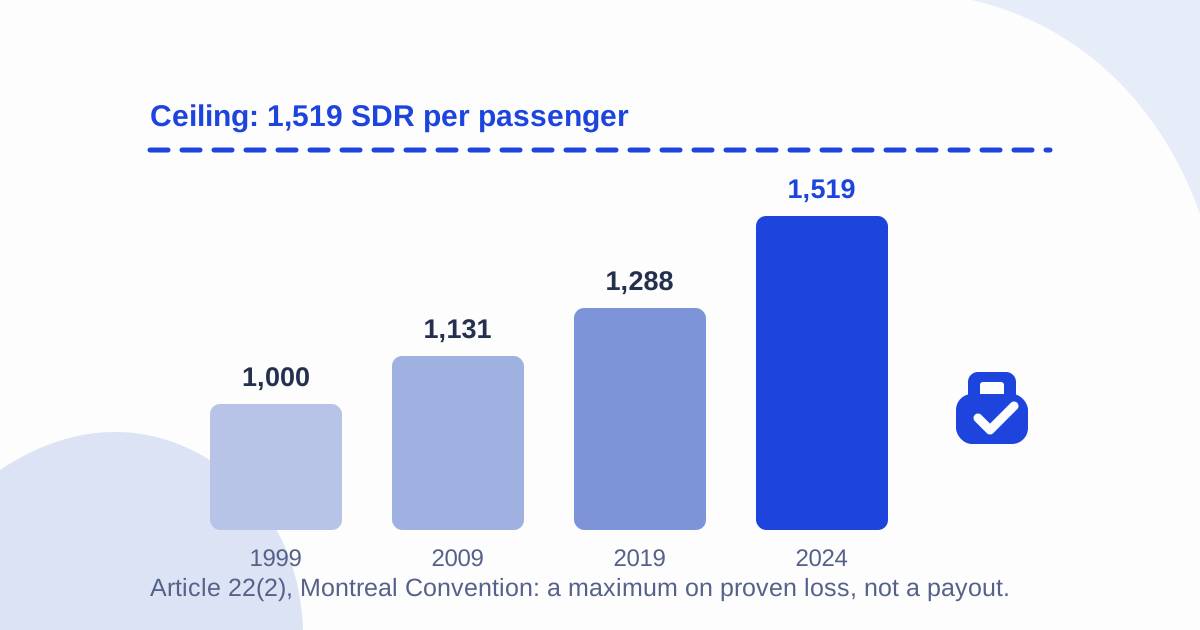
1,519 SDR is the maximum an airline can be liable for per passenger for checked baggage under Article 22(2) of the Montreal Convention, in force since 28 December 2024. SDR stands for Special Drawing Rights, an IMF unit of account, so the euro value moves with exchange rates and sits at roughly EUR 1,800. It is a ceiling on proven loss, not a tariff and not a guaranteed sum: the airline owes what you can document, up to that figure. The limit is per passenger for the whole journey, not per bag and not per flight. Written complaint periods still apply: 7 days from receipt for damage, 21 days from delivery for delay.
A ceiling, not a price list
Article 22(2) of the Montreal Convention sets the maximum an airline can be held liable for when checked baggage is destroyed, lost, damaged or delayed. Since 28 December 2024 that maximum is 1,519 Special Drawing Rights for each passenger. The word that carries all the weight is maximum.
This is the single most common misreading of a baggage claim. The limit does not say what the airline owes you, only the point beyond which it stops owing anything. If a delayed bag cost you 240 EUR in necessary replacements, your claim is worth 240 EUR, not 1,519 SDR. If a lost bag genuinely contained 3,000 EUR of documented property, the airline's liability still stops at the cap unless a special declaration was made at check-in.
So the figure is useful for one thing only: knowing when your documented loss is large enough that the ceiling, rather than your evidence, becomes the binding constraint. Below that point, the number that matters is the one your receipts support.
What an SDR actually is
SDR stands for Special Drawing Rights. It is not a currency you can hold or spend. It is a unit of account created by the International Monetary Fund, valued against a basket of major currencies: the US dollar, the euro, the Chinese renminbi, the Japanese yen and the pound sterling.
The Convention is written in SDR precisely so the limit does not have to be renegotiated every time a currency moves. The consequence for a passenger is that the cap has no fixed euro value. The IMF publishes the SDR rate daily, and 1,519 SDR converts to roughly EUR 1,800 at recent rates. Treat that as an approximation with movement in it, not a number to quote in a claim letter.
When it matters, the conversion is done at the date used by the applicable rules or the court hearing the case, not at the date of your flight or the date you happened to look up a rate.
- SDR is an IMF unit of account, not a spendable currency.
- Its value follows a five-currency basket and changes daily.
- 1,519 SDR is roughly EUR 1,800, subject to the prevailing rate.
- Quote the SDR figure in correspondence and let the euro value follow.
Why the number keeps changing
Article 24 of the Convention requires the depositary, ICAO, to review the liability limits every five years against accumulated inflation. If a majority of States Parties do not object, the revised limits take effect six months after notification. That is why the figure you find online depends heavily on when the page was written.
The baggage limit under Article 22(2) has moved four times, and older guides quoting 1,131 or 1,288 SDR are simply out of date rather than wrong for their moment:
- 1,000 SDR: the original limit in the 1999 Convention text.
- 1,131 SDR: first revision, effective 30 December 2009.
- 1,288 SDR: second revision, effective 28 December 2019.
- 1,519 SDR: current limit, effective 28 December 2024, an increase of about 17.9 percent.
Per passenger, not per bag
The text says 1,519 SDR for each passenger. It does not say per suitcase, per flight or per airline. A family of four travelling together has four separate caps, one attached to each ticketed passenger, even if their belongings were spread across two shared bags.
The reverse also holds and catches people out. One passenger who checked three bags, all of which were lost, still has a single ceiling of 1,519 SDR covering the whole journey. A connecting itinerary flown by two carriers does not double it either: where both the first and last carrier are liable, the cap applies once and the airlines settle between themselves.
The cap also covers destruction, loss, damage and delay together rather than offering a separate allowance for each. If a bag arrives late and damaged, both heads of loss are assessed against the same ceiling.
The airline owes proven damage, up to the cap
Underneath the ceiling, the Convention compensates actual damage. That means the burden sits with you to show what was lost and what it was worth, in a form a claims reviewer can verify. Assertion is not evidence, and a round number with no documents behind it is the easiest kind of claim to reduce.
What that looks like in practice depends on the disruption. Delay is proven with itemised receipts for reasonable essentials bought while the bag was missing, plus a short note on why each purchase was necessary. Damage is proven with photographs, a repair quote or a realistic depreciated replacement value. Loss is proven with an inventory, purchase records, order histories or bank statements, adjusted for the age and use of the items.
Depreciation is normal and expected. A three-year-old jacket is not claimed at its original retail price. Presenting a sensible depreciated figure yourself tends to survive review better than an inflated one that invites a counter-offer.
- Build the total from itemised lines, each tied to a document.
- State one total in one currency, with the conversion basis if needed.
- Apply realistic depreciation before the airline does it for you.
- Keep delay, damage and loss separate: different evidence, different deadlines.
The deadlines that quietly end the claim
The cap is irrelevant if the written complaint arrives late. The Convention sets short, strict periods that run from receipt of the bag, not from the date you finish gathering receipts or from the airline's reply.
For damaged baggage the written complaint must reach the carrier within 7 days of receiving the bag. For delayed baggage the period is 21 days from the date the bag is delivered back to you. If a bag never arrives, it is generally treated as lost once 21 days have passed since it should have arrived, and the loss claim proceeds from there. Separately, there is a two-year long stop for bringing legal action.
A Property Irregularity Report filed at the airport starts the tracing file and is valuable evidence, but airlines usually do not treat it as the written compensation claim. File the written claim through the operating carrier's official route and keep the confirmation.
This is not EU261, and the confusion costs money
Regulation (EC) 261/2004 and the Montreal Convention solve different problems, and mixing them up is why people arrive expecting a fixed sum. EU261 covers the passenger's own journey: denied boarding, cancellation and long flight delay, with fixed compensation of 250, 400 or 600 EUR depending on distance, payable regardless of what the disruption actually cost you.
Baggage is not in EU261 at all. A mishandled suitcase on an otherwise punctual flight gives you no EU261 entitlement, and there is no fixed 250 EUR for a late bag. Baggage sits under the Montreal Convention, which pays documented loss up to 1,519 SDR and pays nothing for a loss you cannot evidence.
The two can apply to the same trip without overlapping. If your flight was cancelled and your bag was later damaged, the EU261 claim and the baggage claim are separate, with separate legal bases, separate evidence and separate deadlines. File them as two claims.
- EU261: flight disruption, fixed amounts, no receipts required.
- Montreal Convention: baggage, proven loss only, capped at 1,519 SDR.
- A delayed bag on a punctual flight is a Convention claim, not EU261.
- Both can arise from one trip and should be filed separately.
When the airline offers less than the claim is worth
A low first offer is routine rather than final. Airlines frequently respond with a flat goodwill figure, a voucher, or a per-kilogram calculation that has no basis in the Convention. None of these override your entitlement to documented loss up to the cap.
Reply in writing, keep it factual, and make the gap easy to see. Restate the legal basis as Article 22(2), attach the itemised schedule alongside the offer, and identify precisely which documented lines the offer fails to cover. Ask for written reasons for any rejected item. That request alone often moves the number, because a reviewer must then justify a reduction rather than simply apply a default.
If the airline holds its position, the escalation route runs through the national enforcement body or the relevant alternative dispute resolution scheme, and ultimately the courts within the two-year period. Vouchers are worth checking carefully: accepting one may be framed as full and final settlement of the claim.
- Do not accept a first offer as final, and read any settlement wording.
- Cite Article 22(2) and attach the itemised schedule with the offer.
- Ask for written reasons for each rejected or reduced line.
- Escalate to the national body or ADR scheme if the reply does not move.
Work out your own figure first
Before contacting the airline, put a defensible number on the claim. Total the documented lines, apply depreciation honestly, and compare the result against the ceiling. In most delay and damage cases the total lands well below 1,519 SDR, which means the cap never binds and the argument is only ever about evidence.
The BagClaim compensation calculator at /compensation-calculator gives a structured estimate from the disruption type and your documented costs, and shows where the total sits against the Convention limit. It is an estimate to plan with, not a promise of what an airline will pay.
- PIR or tracing reference and the original baggage tag
- boarding passes or booking confirmation for the affected journey
- delivery date, or the date the bag was declared lost
- itemised receipts with a short necessity note for each cost
- one clear total, with the SDR ceiling noted for context
Fonti primarie
Utilizziamo materiale primario e ufficiale per le scadenze e il quadro di responsabilità in questa guida. Le condizioni aeree e i fatti di un viaggio individuale devono ancora essere controllati.
Trasformare la lista di controllo in un reclamo verificabile.
Controllare la linea temporale, organizzare le ricevute e costruire la lettera prima di aprire la rotta ufficiale di deposito della compagnia aerea.
Verifica il mio reclamo