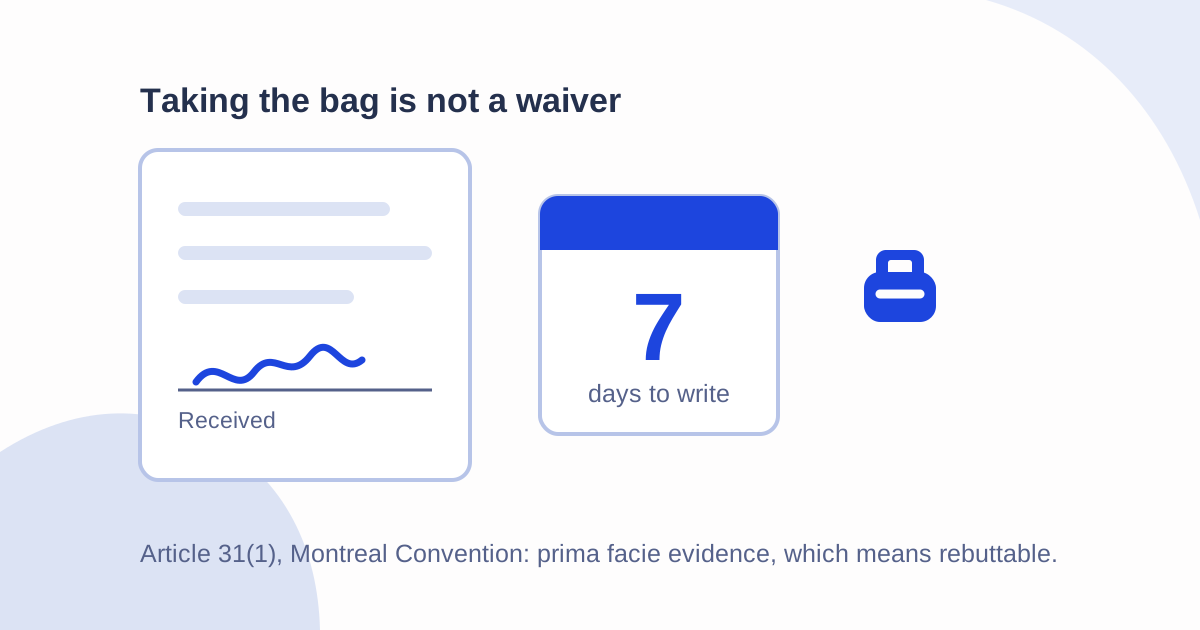
No, taking the bag without saying anything does not by itself end the claim. Article 31(1) of the Montreal Convention says receipt without complaint is prima facie evidence that the baggage was delivered in good condition. Prima facie evidence is a starting presumption that can be rebutted, not a waiver of your rights. What actually matters is Article 31(2): you must complain to the carrier in writing forthwith after discovering the damage, and at the latest within seven days from the date you received the checked bag. If you are inside those seven days, write now, date the discovery, and show why the damage could not reasonably have been seen at the belt.
What signing for the bag legally means
Airlines answer this situation with a stock line: you collected the bag and raised nothing, so it was delivered undamaged. The Convention does say something close to that, but not as strongly as the refusal letter implies. Article 31(1) reads: "Receipt by the person entitled to delivery of checked baggage or cargo without complaint is prima facie evidence that the same has been delivered in good condition and in accordance with the document of carriage."
The operative words are prima facie evidence. That is a legal standard meaning the presumption holds unless it is displaced by other evidence. It is not conclusive proof, and it is not a waiver. The Convention did not say the right is extinguished, and it knows how to say that when it means it: Article 35 uses exactly that word for the two-year action deadline. The drafting difference is deliberate.
So the question after a late discovery is never "did I sign?" It is "can I show the bag was in fact damaged in the carrier's hands?" That is an evidence question, and evidence questions are winnable.
The deadline that actually decides it
The clause that can genuinely end a damage claim is the next one. Article 31(2) requires that in the case of damage the person entitled to delivery must complain to the carrier forthwith after the discovery of the damage, and at the latest within seven days from the date of receipt in the case of checked baggage. Article 31(3) adds that every complaint must be made in writing and dispatched within that time, and Article 31(4) states that if no complaint is made within the time aforesaid, no action shall lie against the carrier, save in the case of fraud on its part.
Read those together and the picture is the opposite of the one the airline paints. The seven days run from receipt of the bag, not from the flight and not from the moment you noticed. The Convention plainly contemplates that damage is discovered after delivery, otherwise a seven-day window would be pointless: if the only valid complaint were one made at the belt, no further period would be needed at all.
That is the argument to make. Silence at the carousel is answered by Article 31(1) and is rebuttable. Silence past day seven is answered by Article 31(4) and is not. Everything therefore turns on getting a written complaint in during that week.
- Damage: complain in writing within 7 days of receiving the bag (Article 31(2)).
- Delay: 21 days from the date the bag was placed at your disposal.
- In writing and dispatched inside the window, not merely drafted (Article 31(3)).
- Miss it and no action lies against the carrier, absent fraud (Article 31(4)).
The carriers write it into their own conditions
This is not a passenger-side reading. The same structure appears in the airlines' own published conditions of carriage, which is useful because a refusal letter is easier to answer with the carrier's own wording than with a treaty.
Qatar Airways states in Article 17 of its conditions of carriage that "No action shall lie in the case of damage to Checked Baggage unless the person entitled to delivery complains to us forthwith after the discovery of the damage, and, at the latest, within seven days from the date of receipt", and adds that "Every complaint must be made in writing and dispatched within the time aforesaid." Qantas puts the same rule in its own words: a claim for damage must be made in writing "as soon as you discover the damage after you have received the Baggage, and at the latest within 7 Days."
Both formulations are built on discovery, not on the moment of collection. Neither says that accepting the bag ends the matter. If a decision letter tells you it does, quoting the carrier's own clause back at it is a short and effective reply.
How to rebut the presumption in practice
Rebutting Article 31(1) means giving a reviewer a plausible, evidenced account of damage occurring in transit that was not visible when you collected the bag. Concealed damage is common and easy to describe: a cracked internal frame under an intact shell, a wheel housing sheared on the inside, a hairline split along a seam that only opens when the case is unpacked, contents broken inside a bag that looks fine from the outside.
Photograph before anything moves. A photograph of the closed bag with the airline tag still attached is worth more than a close-up of the crack alone, because it ties the damaged object to that flight. Keep the bag, the tag and any packaging exactly as they are until the claim is decided, since many carriers reserve the right to inspect and a repaired or discarded bag ends the discussion.
Then write the sequence plainly and let the dates carry it: landed, collected, opened at home, found the damage, wrote to the airline. If each of those has a timestamp, the claim explains itself and the signature at the belt stops being the interesting fact.
- Photograph the bag with the baggage tag still attached, before unpacking further.
- Record the date and place of discovery, and say what made the damage invisible at the airport.
- Keep the bag, the tag and the boarding pass or booking confirmation.
- Get a repair quote or a replacement price, so the amount rests on evidence.
- Send the complaint through the carrier's published baggage route and keep the confirmation.
Answering a refusal that leans on your signature
If the airline has already refused, keep the reply short and structured. Name the flight and file reference, state the date you received the bag and the date you discovered the damage, and point out that your written complaint was made within seven days of receipt as Article 31(2) requires.
Then address the presumption directly rather than ignoring it. Acknowledge that you collected the bag without comment, explain in one sentence why the damage was not apparent at that point, and attach the photographs and the repair or replacement evidence. Ask for a written decision on the evidence supplied. That is a reply a reviewer can act on, and it is much harder to answer with the same stock paragraph twice.
One thing not to do is inflate the figure while you are arguing about the principle. The Montreal Convention baggage limit is 1,519 Special Drawing Rights per passenger from 28 December 2024, and it is a ceiling on proven loss rather than a payout. A modest, fully receipted number strengthens exactly the point you are making, which is that the claim rests on evidence.
If the seven days have already passed
Be straight about this: once the written complaint period has gone by, Article 31(4) says no action lies against the carrier except in the case of fraud on its part. That is a real bar and no amount of evidence about the damage itself gets around it.
It is still worth writing, because a carrier can choose to consider a late claim as a commercial matter even when it is not obliged to, and some do. Send the same clean record you would have sent on day three and make no claim about the deadline that is not true. What you should not do is let a claim that is still inside its window drift into this position: if you are on day four and reading this, the useful next step is to write today rather than to gather one more quote.
- Inside 7 days: write now, then complete the evidence afterwards.
- Past 7 days: you may still ask, but the carrier is not obliged to consider it.
- Either way, keep the two-year Article 35 action deadline in view.
Primary sources
We use primary and official material for the deadlines and liability framework in this guide. Airline conditions and the facts of an individual journey still need to be checked.
Turn the checklist into a reviewable claim.
Check the timeline, organise the receipts and build the letter before opening the airline's official filing route.
Check my claim